
A number of events had transpired that began the transformation of my heart, and the…
Listen, Forget, Remember: Tuning In with Psalm 45
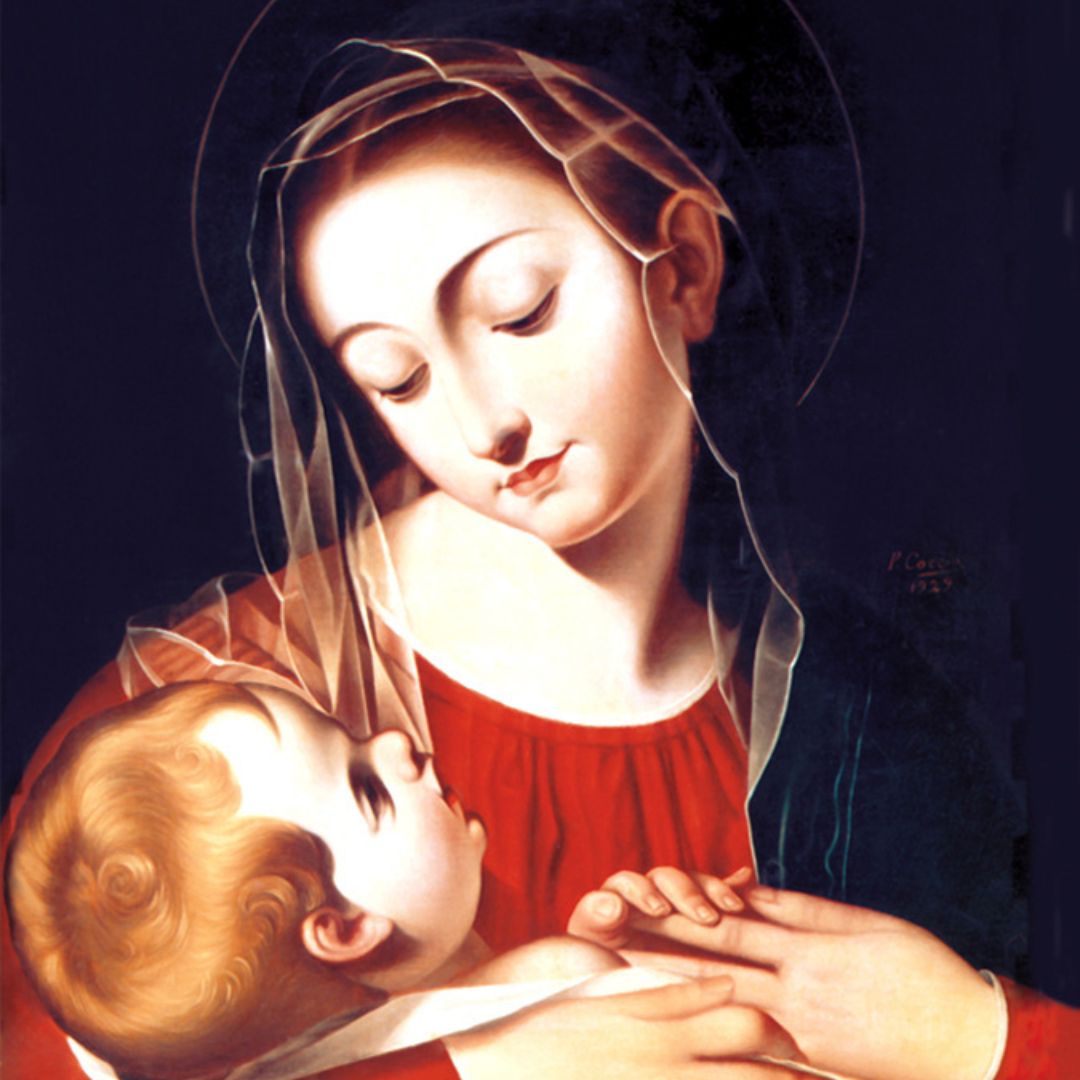
Our Lady Of Divine Providence, whose ear is ever bent toward the Holy Spirit and toward us…
Refrain: Listen to me, daughter; see and bend your ear.
Hear, O daughter, and see; turn your ear,
forget your people and your father’s house.
So shall the king desire your beauty;
for he is your lord, and you must worship him.All glorious is the king’s daughter as she enters;
her raiment is threaded with spun gold.
In embroidered apparel she is borne in to the king;
behind her the virgins of her train are brought to you.They are borne in with gladness and joy;
they enter the palace of the king
The place of your fathers your sons shall have;
you shall make them princes through all the land.
Oh, my dear Jesus, thank you for this invitation, straight from your heart to mine, in today’s psalm. What desire you have for me to be your own–“Hear!” “See!” “Turn your ear!”–tune your ear to Me. You know the static that trips me up in the tuning. My “people.” My “father’s house.” Code for everything that populates my spinning mind and divided heart, compromising my yielding to you. Voices that shame rather than lovingly convict, a self-sufficiency which magnifies the pressures of the day… Pride, perfectionism, judgmentalism, the list goes on–not to mention my preconceptions about how life should look, moment to moment, and expectations, waking up in the morning, about how the day is going to unfold–all of it so often confounded by what actually occurs. Even your faithful interior alerts can lead down the introspective path of figuring-it-out. This only compounds the “ego-drama,” as Bishop Barron would say, when our call is to allow your “Theo-drama” to enfold us.
How earnest is your pleading, in this psalm’s refrain punctuating every verse–“Listen to me, daughter.” Listen. And what are you urging us hear? Your insistent “forget.” Not “renounce,” which carries a punch, but a tender “forget.” “Lose the power of recalling to mind,” says Webster–like the gentle dementia of an old person. Such an ache in your request, dear Jesus, to leave “your people” and “your father’s house” behind, inserting them in your Cross as I go… After all, you descended into hell. I say it every Sunday in the Creed. You descended into my hells, more specifically, and took them into your Resurrection with you. So I am safe to let go of all that constricts me. You entitled me to “forget.”
And what shall I remember? Something must fill that vacuum. You are stunningly unambiguous– “So shall the king desire your beauty.” You see, always, what I miss, what shame and fear preclude. I radiate–I become whom you see always–when I “forget” to worship the all-about-me, my self-preoccupations, and see, and turn my ear to, the all-about-You. You wish to fill me with your entirety, just as you “fill the universe in all its parts,” to quote St. Paul (Eph. 1:23). You ache to be my Lord, to fill the space occupied by my errant appetites, my failures and inadequacies, my spiraling emotions, my insecurities, my disappointments, the doubts and fears that come to bite. I can believe, dear Jesus, that you want to be my sufficiency. There’s so much in me that is insufficient! But can I believe the psalmist’s crucial word, “desire,” the key? Pope Benedict XVI referred to your “mad eros”–your unquenchable thirst for me–from the Cross. It is not our theological notions of your satisfying for us, repairing for us, compensating for us, astounding though these be, which inform us of our beauty. It is only grasping what lies beneath: the fiercest, most jealous, most specific and personal, most magnificently possessive love we could imagine. How you pine for us in the Song of Songs: “You ravish my heart, my sister, my bride.” Let me be ravished by you, dear Jesus. Let me absorb, “I am my Beloved’s, and his desire is for me.”
Can it truly be that you are helpless in your love for me? That your passion for me allows me amnesia about all my “stains and wrinkles and anything of that sort” (Eph. 5:27) if I assent to it? That as I let you love me, “forgetting” any sense of earning it, or performing well, our oneness crowns me a “king’s daughter,” “all glorious?” Let our communion, dear Jesus, enable me to “see and bend (my) ear” to the “raiment threaded with spun gold” you offer me in every circumstance of my day. May I “forget my people”–my agenda, my perspective, the mire of my own inner loop–in the splendor of your turning leaves, the sudden warmth of the cashier’s eyes in the supermarket, a suddenly cloudless sky. These are your love’s disguises! Let holy dementia overtake my fallen filters in response to my present moment, whatever it holds, and give me yours instead. My one job–to forego control, to relax, to receive you.
And thank you, dearest Lord, that I am not alone as I “enter the palace of the king.” Such companions you have given me, “borne in with gladness and joy” in that elation we share filled with you. My spiritual family! Here all is right with the world, on into the eternal Communion of Saints.
But you don’t stop there. You are ever expansive. You ask me to bend my ear to your closing promise–that as I yield to your desire for me, forget “my people and my father’s house” and simply receive being in you, the beat will go on. Grace builds on nature. The inheritance continues, expanding up and down the family tree. “The place of your fathers your sons shall have.” And what honor you give me–that in you I “shall make them princes through all the land.” How unfathomable such stature.
Mary, our Mother, you are the enfleshment of this psalm. You listened. You saw, and you bent your ear. You forgot your people and your father’s house. You yielded to your king’s desire for your beauty. You are all glorious in your spun gold. We are the virgins of your train, behind you, borne into the king’s palace with gladness and joy. Your “yes” has made us princes with your Son! Mother us to Him, dear Queen of our hearts. Open our ears to who we are in His tender, astonishing love. Totus Tuus.
Bonnie West – Copyright 2026

Related Posts



Comments (0)